
11 Public Speaking Techniques the World's Best Speakers Actually Use

Most people watch great speakers the way they watch magicians. They see the effect and assume there is no method behind it. There is. The difference between the speakers you envy and the speakers you have become is not talent. It is a specific set of techniques that the best speakers in history developed, refined, and reused — often deliberately, sometimes by accident, always with intent.
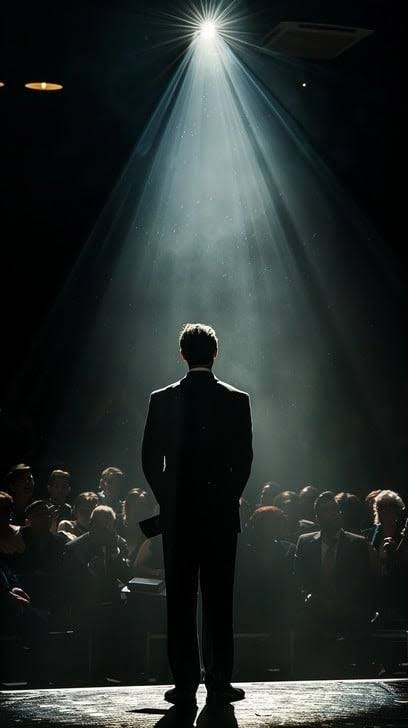
Below are eleven of them, drawn from the actual practices of world-class speakers across politics, business, entertainment, and performance. Each one is small. Each one is copyable. And each one, run consistently, moves you closer to the version of yourself that the room actually turns to listen to.
1. Create an alter ego
The instinct is to walk on stage as yourself. For many speakers, this is a mistake — especially early on, when you do not yet have the confidence to match the role you are stepping into.
Beyoncé built “Sasha Fierce” early in her career to perform with a confidence she did not yet feel personally. Over years, as her real confidence grew, the persona and the person merged. Cary Grant once said he pretended to be someone he wanted to be until, eventually, they met somewhere along the way and became the same person.
Research on this practice calls it a form of self-distancing — stepping outside yourself so you can act with more objectivity and less fear. In practical terms, it looks like this. Pick three or four speakers you admire. Study how they move, joke, hold silence, occupy space. Then, before you speak, step into that larger-than-life version of yourself. You do not have to be them. You have to give yourself permission to act more confidently than you feel. The strange part is that after enough reps, the persona stops being a costume and starts being you.
2. Raise your heart rate before you speak
A great speech starts before you step on stage. Most speakers wait until they are nervous, then try to calm themselves down. The best ones do the opposite. They intentionally raise their heart rate first, so the nerves have somewhere to burn off.
Taylor Swift trained for the Eras Tour by singing her full setlist on a treadmill every day for six months. She was building muscle memory for delivering under physical stress, so that when the actual show started her body knew what to do with the energy. Tony Robbins uses a pre-speech ritual involving a mini trampoline, cold plunge, dancing, and power poses. The pattern is the same. Move the body first. Let the nervous system arrive at the speech already regulated, not still trying to figure out what is happening.
Practical version: do a moderate-to-intense workout a few hours before your talk, then rehearse the opening while your heart is still elevated. You are training yourself to speak calmly under stress instead of hoping calm will show up on its own.
3. Never let the audience go cold
Most speakers open cold. They walk out, thank the room, and dive into the material. By the time they realize the room is not with them, the first ten minutes are gone.

Comedy MCs almost never do this. They get the audience clapping within the first minute. A show of hands. A quick call and response. Anything that turns a passive room into an active one. The goal is to create a “we are in this together” feeling before the real content starts. Tony Robbins takes this to an extreme — his audiences clap, yell, repeat phrases, dance, and high-five for hours because he refuses to let the temperature drop.
You do not need to run a Tony Robbins level of engagement. But you do need to warm the room. A single question with a show of hands. A quick joke that lands. A moment where the audience does something instead of watches. That warmth carries the rest of the talk.
4. Speak to the room as if you are speaking to one person
The best speakers make audiences of hundreds — or millions — feel personally addressed. Ronald Reagan was a master of this. In the 1980 debate with Jimmy Carter, Carter kept referring to voters in the third person: “The American people...” Reagan turned to the camera and said, “Next Tuesday all of you will go to the polls.” Then he asked the line that quietly ended the debate: “Are you better off than you were four years ago?”
That word — you — is the entire technique. It collapses the distance between the speaker and the listener. Every person in the room hears it as if you are talking directly to them, because you are. Write your next talk with second person in mind. Not “people should” but “you can.” Not “the audience will” but “you will.” It is a small rewrite. The impact is not small.
5. Use rolling conjunctions to make speech memorable
There is a rhetorical device called polysyndeton that shows up in almost every memorable speech ever recorded. It works by repeating conjunctions — and, but, or, nor — where you would normally use commas. The effect is rhythmic. The words start to sound like music.
Reagan used it constantly. Obama built entire passages of his second inaugural on it. You do not need to memorize the rule. You just need to notice what it does. Instead of writing a list separated by commas, you connect the items with and. The sentence slows down. It gains weight. Each item lands as its own beat instead of dissolving into the next one. Try it in your next talk on the sentences you want people to remember. The rhythm alone does most of the work.
6. Master your hands
Bill Clinton perfected a gesture that came to be called the Clinton thumb — a soft, closed hand with the thumb resting on top, used for emphasis. It reads as empathetic rather than aggressive. A pointed finger reads as an accusation. A fist reads as anger. The Clinton thumb reads as certainty without threat.
Great speakers combine this kind of intentional hand work with the rest of their body. Palms open when addressing the audience. Hand on heart for personal points. Body slightly turned toward whoever is speaking. In the 1992 debate, Clinton closed physical distance with the audience, made direct eye contact, and listened intently to the question before answering. The room felt him as being on the same team. That was not accidental. It was choreography.
Start with your hands. Get them out of your pockets. Give them intentional gestures. The rest of your body will follow.
7. Slow down by stretching your vowels
Nervous speakers rush. It is the single most common tell in a nervous talk. The best speakers slow down not just by pausing but by physically stretching their words, especially the vowels.
Margaret Thatcher was famous for this. She drew out consonants and vowels for clarity, injecting weight and emotion into every important sentence. It made her easy to understand and hard to ignore. Try it. Take a sentence that matters in your next talk. Stretch the main vowels slightly longer than feels natural. The sentence will land twice as hard. The room will slow down with you.
8. Vulnerability is a tool, not a default
Sara Blakely opens her Spanx story with the moment she saw panty lines through white pants and decided to solve it herself. It is intimate. It is relatable. It works because she is selling connection and everyday problem-solving.
Vulnerability does not work in every context. When JFK spoke to a nation looking for reassurance, he hid severe back pain and Addison’s disease. Not because he was ashamed. Because his job in that moment was to project sturdiness, not humanity. A leader trying to steady a country cannot afford to look shaky.
The technique is not “be vulnerable” or “never be vulnerable.” It is knowing which one the moment calls for. Connection with a small audience? Open up. Steadying a large one through fear? Project strength. Read the room, then choose.
9. Filler words can be used on purpose
The standard advice is to eliminate every um and like. Most of the time, this is right. But it is not a universal rule.
Elon Musk uses filler words constantly. He stumbles, restarts sentences, and pauses mid-thought. And yet he captivates the room. The reason is that he is painting an exciting future — self-driving cars, brain chips, Mars — and the fillers make him sound like someone thinking in real time about something huge. He does not sound media-trained. He sounds real.
Steve Jobs used a completely different technique — clean, conversational, deceptively simple. Both worked. The lesson is not to imitate either one. It is to understand that fillers are not always the enemy. What matters is whether the audience feels you have something worth saying. If you do, occasional fillers humanize you. If you do not, no amount of polished delivery will save you.
10. End with a clear call to action
Almost every speech people remember for decades ends the same way: with a specific action the audience is being asked to take.
Martin Luther King’s “I Have a Dream” builds to a call for freedom and equality that leaves the audience nowhere to go except toward that action. Amelia Earhart urged women to take their place in science and industry. Churchill built to the closing line about never surrendering — using repetition to hammer the call home. Every one of these speeches gives the audience somewhere to go when it ends.
Most speakers end with a summary. Do not. Reserve time for a real call to action. Write it until you feel the exact emotion you want the audience to leave with. That emotion is what carries them out of the room and into the thing you are asking them to do.
11. Build a public speaking portfolio
The final technique is the one nobody wants to hear. Say yes to every small speaking opportunity you get. Panels. Toasts. Introductions at events. Meetings where you would normally stay quiet. All of it.
The reason is compounding. Every small talk you give is a rep. Every rep builds a foundation. And by the time a real opportunity arrives — the keynote, the pitch, the moment that matters — you have a portfolio behind you that makes the big moment feel like just another rep. Dale Carnegie said it plainly: you must learn to speak by speaking.
The people who look natural in front of a room are almost never people who waited for the big moment to practice. They practiced on every small stage they could find, for years, until the big one no longer felt big.
The speakers you envy are not more gifted. They built a portfolio the world never saw and stepped on stage after hundreds of quiet reps.